The Wash-Dryer Combo Is Cheaper to Buy, Pricier to Run
The Bosch Serie 4 WNA13441 wash-dryer combo costs 419 EUR less to buy than a separate washing machine and dryer, but it uses far more electricity per load once you actually run it.
By Nora Fischer · Last updated 7 September 2026
Researched and drafted with AI language-model assistance from CompareHomeAppliances' own verified spec database and cited public sources, per our AI-content disclosure.
Buy the Bosch Serie 4 WNA13441 wash-dryer combo and you pay 899 EUR for one machine that washes and dries. Buy a separate washing machine and dryer instead, the Bosch Serie 6 WUU28T42 and the Siemens iQ300 WT43HV04, and the two together cost 1,318 EUR. That is a genuine 419 EUR saving for the combo, 31.8 percent less than buying separate. The catch shows up the first time you run it: per kilogram of laundry that actually comes out dry, the combo burns a bit over four times as much electricity as the dedicated dryer alone.
Key takeaways:
- The Bosch Serie 4 WNA13441 combo costs 899 EUR. A separate Bosch WUU28T42 washing machine plus Siemens WT43HV04 dryer costs 1,318 EUR combined, so the combo is 419 EUR cheaper, 31.8 percent less.
- Per its own EPREL rating, the combo’s one wash-and-dry cycle uses 3.22 kWh for 5 kg. Running the two separate machines back to back uses just 1.679 kWh combined (0.489 kWh to wash plus 1.19 kWh to dry), while handling more laundry: a full 9 kg washed and up to 8 kg dried.
- Per kilogram of laundry actually dried, the combo uses 0.644 kWh/kg against the standalone dryer’s 0.149 kWh/kg, a bit over four times as much electricity per kilogram dried, and that understates the gap, since the combo’s figure also includes the energy spent washing.
- The combo can only wash-and-dry 5 kg in one cycle despite washing a full 9 kg on its own, sitting at the low end (55.6 percent) of the 55.6 to 66.7 percent dry-to-wash ratio range an earlier analysis on this site found across all six Bosch combos.
- Among five priced Bosch combos, price and wash capacity don’t reliably buy drying value: the priciest, largest-wash-capacity model in the lineup is the second-worst on euros per kilogram of dry capacity.
What are we actually comparing here?
A wash-dryer combo is one freestanding machine with one drum. Load it, and it washes, then dries, the same clothes in a single cycle, no moving laundry between machines. A separate setup is two machines: a washing machine that only washes, and a dedicated dryer that only dries, each with its own drum and its own rated capacity.
The three models at the center of this comparison are all registered in the EU’s EPREL energy database under the identical legal manufacturer, BSH Hausgeräte GmbH. Bosch and Siemens are both BSH-group brands, confirmed directly against each model’s own EPREL record, which is what makes putting a Bosch machine up against a Siemens machine here a fair, same-manufacturer-group comparison rather than an apples-to-oranges one.
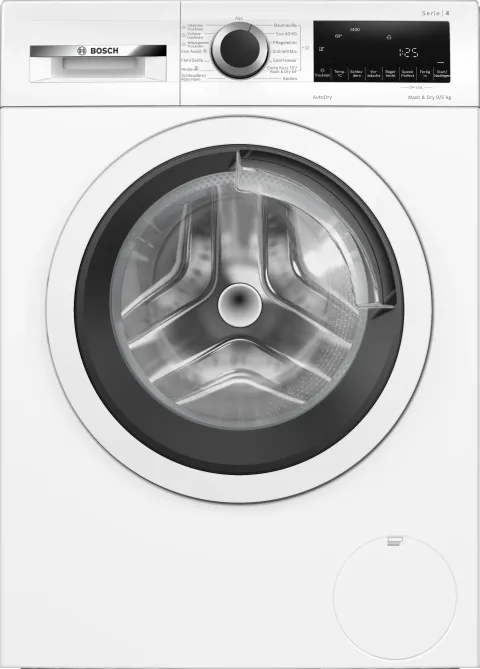
- The Bosch Serie 4 WNA13441: a freestanding wash-dryer combo, 899 EUR, energy class E, 9 kg wash-only capacity but only 5 kg when washing and drying in the same cycle.
- The Bosch Serie 6 WUU28T42: a standalone washing machine, 699 EUR, energy class A, 9 kg wash capacity, matching the combo’s own wash-only figure exactly.
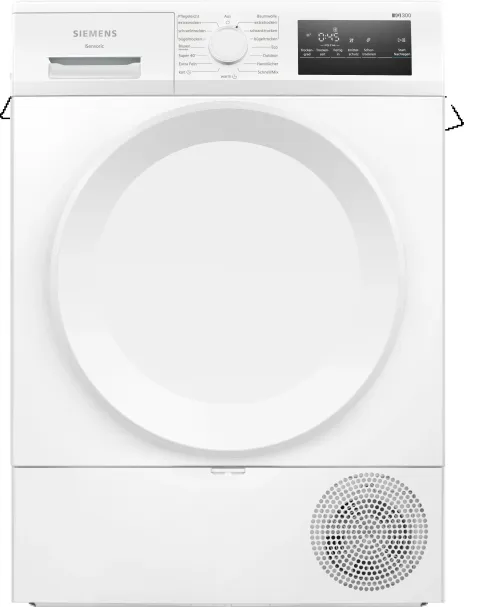
- The Siemens iQ300 WT43HV04: a standalone heat-pump tumble dryer, 619 EUR, energy class D, 8 kg dry capacity, more than the combo can dry in a single cycle.
Does the combo actually save you money upfront?
Yes, and it’s worth saying plainly: this saving is real, not a rounding trick. Add the washing machine and the dryer together, 699 EUR plus 619 EUR, and separate ownership costs 1,318 EUR. The combo alone is 899 EUR. That is a 419 EUR gap, the combo costing 31.8 percent less than the 1,318 EUR separate total, or looked at the other way, buying two separate machines costs 46.6 percent more than the combo.
| Route | Machines | Price (EUR) |
|---|---|---|
| Wash-dryer combo | 1 (Bosch WNA13441) | 899 |
| Separate washer + dryer | 2 (Bosch WUU28T42 + Siemens WT43HV04) | 1,318 |
If your only question is “which costs less to buy,” the combo wins outright, by a real 419 EUR. The rest of this piece is about what that upfront saving does, and doesn’t, cost you afterward.
What does each route cost to actually run?
Here the picture flips. Using each machine’s own EPREL-rated figure and this site’s own running-cost assumption of 0.40 EUR per kWh, the combo’s one wash-and-dry cycle draws 3.22 kWh, for 5 kg of laundry that goes in dirty and comes out washed and dry. At 0.40 EUR/kWh, that is 1.29 EUR in electricity for one cycle.
The separate route needs two steps, a wash and a dry, but between them uses less power: 0.489 kWh to wash on the WUU28T42, plus 1.19 kWh to dry on the WT43HV04, for a combined 1.679 kWh, costing 0.67 EUR. And that 1.679 kWh handles more laundry than the combo’s single cycle does, a full 9 kg washed and up to 8 kg of it fully dried, against the combo’s 5 kg washed and dried together. Put simply, the two separate machines use only about 52 percent as much electricity as one combo cycle, while doing more laundry, not less.
The cleanest version of this comparison strips out any scaling or estimating and just divides each machine’s own rated energy figure by its own rated capacity. The combo uses 3.22 kWh for its own 5 kg wash-and-dry rating, 0.644 kWh per kilogram dried. The dedicated Siemens dryer uses 1.19 kWh for its own 8 kg rating, 0.149 kWh per kilogram dried. Divide one by the other and the combo uses 4.33 times as much electricity per kilogram of laundry it actually gets dry. That figure is if anything generous to the combo: its 0.644 kWh/kg includes the energy spent washing as well as drying, while the dryer’s 0.149 kWh/kg is drying only.
This is exactly the capacity shortfall we documented earlier across the whole Bosch wash-dryer lineup, applied to this specific machine. That analysis found dry capacity across all six Bosch combos in the catalog averages 61 percent of wash capacity, ranging from 55.6 to 66.7 percent. The WNA13441 sits right at the low end of that range, at exactly 55.6 percent, meaning it can wash nearly double what it can dry in the same cycle. The capacity shortfall and the higher running cost are two separate downsides of the same design choice, not one problem counted twice: one is about how much laundry fits in a cycle, the other is about how much electricity that cycle burns. They compound.
What this comparison does not attempt is an annual running-cost or payback figure. A combo and a separate pair get used at different frequencies in real households, and forcing an annual number here would rest on assumptions this dataset can’t honestly support. The per-cycle and per-kilogram figures above are fully sourced from each machine’s own EPREL rating and need no extrapolation, which is exactly why they’re the numbers used here.
Does a bigger, pricier combo at least buy you more drying power?
Not reliably. Five Bosch wash-dryer combos in the catalog currently carry a price, and dividing each one’s price by its own dry capacity tells a different story than sticker price or wash capacity alone would suggest.
| Model | Price (EUR) | Wash capacity (kg) | Dry capacity (kg) | EUR per kg of dry capacity |
|---|---|---|---|---|
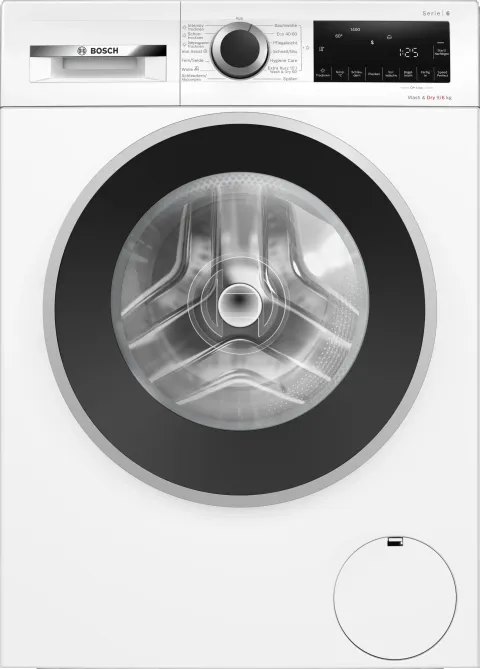
| Bosch Serie 6 WNG24442 | 999 | 9.0 | 6.0 | 166.50 |
| Bosch Serie 8 WNC244070 | 1,049 | 9.0 | 6.0 | 174.83 |
| Bosch Serie 4 WNA13441 | 899 | 9.0 | 5.0 | 179.80 |
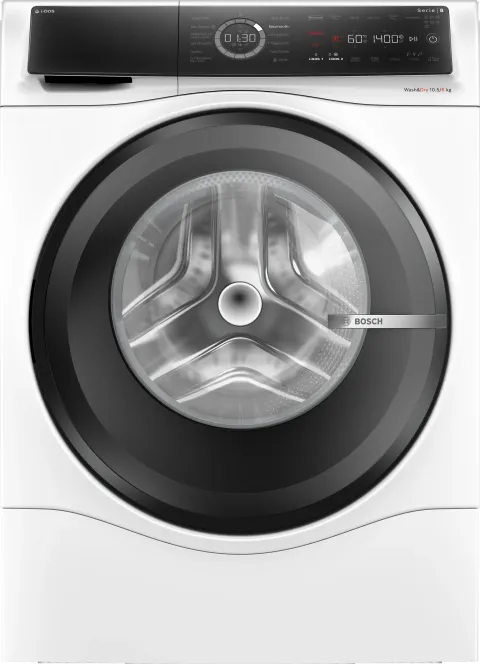
| Bosch Serie 8 WNC254A40 | 1,299 | 10.5 | 6.0 | 216.50 |
| Bosch Serie 6 WKD28490 | 1,369 | 8.0 | 5.0 | 273.80 |
The Bosch Serie 8 WNC254A40 is the priciest model here and has the largest wash capacity in the group, 10.5 kg, at 1,299 EUR. On drying value it is the second-worst in the entire lineup, 216.50 EUR per kilogram of dry capacity, beaten only by the WKD28490. The best value is the Bosch Serie 6 WNG24442, a middling 999 EUR price that works out to the lineup’s best rate, 166.50 EUR per kilogram of dry capacity. A sixth model, the Bosch Serie 6 WKD28543 (7 kg wash, 4 kg dry), currently carries no price on file and is correctly left out of this table. Bigger wash capacity and a higher sticker price do not reliably buy more drying power per euro; on this data, they can buy you noticeably less.
So which should you actually buy?
The combo genuinely earns its place in one specific situation: a household with room and plumbing for exactly one laundry machine, not two. That’s a common, real constraint in smaller EU and German apartments, where a single washing machine slot is often all there is, and a second appliance simply has nowhere to go.
Outside that constraint, the combo is not a free lunch. It really is 419 EUR cheaper to buy than the separate route, and that saving is genuine. But it also costs more electricity per load, handles less laundry per cycle, and, per the capacity gap detailed above, can never dry the full load it just washed in one go. That’s a real trade-off with an answer that depends on your actual living situation, not a case where one option is simply better than the other.
If you have the space for two machines, the Bosch Serie 6 WUU28T42 washing machine paired with the Siemens iQ300 WT43HV04 dryer costs more upfront but less to run, and it does more laundry per cycle to boot. If you don’t have that space, the Bosch Serie 4 WNA13441 is a genuinely reasonable way to fit both jobs into one footprint, as long as you go in knowing what the 419 EUR saving costs you later. Line up any of these models side by side yourself in the comparison tool before you decide.
Appliances in this analysis
Bosch
Serie 4 WNA13441
Bosch
Serie 6 WUU28T42
Siemens
iQ300 WT43HV04
Bosch
Serie 6 WNG24442
Bosch
Serie 8 WNC254A40
Related categories
Frequently asked questions
What is a wash-dryer combo, and how is it different from a separate washing machine and dryer? +
A wash-dryer combo is one freestanding machine, one drum, that washes and then dries the same load without you moving anything. A separate setup is two machines, a washing machine and a dedicated dryer, each with its own drum and its own rated capacity. The combo saves floor space and plumbing; two separate machines are typically cheaper to run and handle more laundry per cycle.
Is a 2-in-1 washer-dryer cheaper than buying a washing machine and dryer separately? +
Yes, to buy. The Bosch Serie 4 WNA13441 combo costs 899 EUR. A separate Bosch Serie 6 WUU28T42 washing machine (699 EUR) plus a Siemens iQ300 WT43HV04 dryer (619 EUR) comes to 1,318 EUR, so the combo is 419 EUR cheaper, 31.8 percent less than the separate total. That upfront saving is real. It is not the whole story once you look at running costs and capacity.
Why does a wash-dryer combo use more electricity per load than separate machines? +
Washing and drying in the same drum, in one cycle, is a less efficient way to remove water than a dedicated heat-pump dryer built for that job alone. On their own EPREL-rated cycles, the WNA13441 combo uses 3.22 kWh to wash and dry 5 kg. Running the separate route, a wash on the WUU28T42 plus a dry on the WT43HV04, uses 1.679 kWh combined for a full 9 kg wash and up to 8 kg dried. Per kilogram actually dried, the combo uses roughly 4.33 times as much electricity as the dedicated dryer alone.
When does a wash-dryer combo actually make sense? +
When you genuinely have room and plumbing for one laundry machine, not two, most often a small apartment where a single washing machine would otherwise go. Outside that constraint, the combo is a real trade-off, not a clear win: 419 EUR cheaper to buy, but pricier per load, smaller-capacity per cycle, and unable to dry the full load it just washed.
Sources
- Bosch Serie 4 WNA13441 wash-dryer product page
- Bosch Serie 6 WNG24442 wash-dryer product page
- Bosch Serie 8 WNC254A40 wash-dryer product page
- Bosch Serie 6 WUU28T42 washing machine product page
- Siemens iQ300 WT43HV04 tumble dryer product page
- EPREL registration, Bosch Serie 4 WNA13441 (washer-dryer)
- EPREL registration, Bosch Serie 6 WUU28T42 (washing machine)
- EPREL registration, Siemens iQ300 WT43HV04 (tumble dryer)
- European Commission, washer-dryers product list
More from the blog