Bosch's Built-In Wine Cooler Costs 490 EUR More
Bosch's built-in and freestanding 44-bottle wine coolers match spec for spec, but the built-in one costs 490 EUR (34%) more and barely less to run.
By Nora Fischer · Last updated 3 September 2026
Researched and drafted with AI language-model assistance from CompareHomeAppliances' own verified spec database and cited public sources, per our AI-content disclosure.
If you are choosing between a built-in wine cooler and a freestanding one, there is a number you should see before you decide anything else: 490 EUR. That is what Bosch charges extra for a built-in 44-bottle cooler over a freestanding 44-bottle cooler that matches it on every spec that would normally justify a price gap, same capacity, same temperature zones, same range, same noise, same energy class. The built-in unit is not quieter, not more efficient in any way that shows up on your bill, and does not hold more wine. It fits into cabinetry. That is the entire difference, and it costs a third more.
Key takeaways:
- Bosch’s built-in KUW21AHG0 and freestanding KWK16ABGB both hold 44 bottles, both run 2 zones from 5 to 20°C, both hit 38 dB, both carry a G energy rating, yet the built-in one costs 490 EUR more (1,949 EUR vs 1,459 EUR), a 33.6 percent premium.
- The built-in model’s electricity edge, 130 kWh a year against 142 kWh, is worth about 4.80 EUR annually at 0.40 EUR per kWh. At that rate it would take roughly 102 years to earn back the 490 EUR premium.
- Cost per bottle of capacity falls from 57.57 EUR on Bosch’s smallest cooler to 10.75 EUR on its largest, a 5.4 times drop, making the biggest unit the sharpest euro-for-euro buy in the lineup despite its highest sticker price.
- All four Bosch wine coolers, from 21 bottles to 199 bottles, measure exactly 38 dB. Noise will not help you choose between them.
- The 199-bottle KWK36ABGA is rated G, the worst class on the label, while using just 0.78 kWh per bottle per year, about six times less per bottle than the F-rated 21-bottle model’s 4.76 kWh. The letter grade and the per-bottle math point in opposite directions.
Why does the built-in model cost 490 EUR more for the same wine cooler?
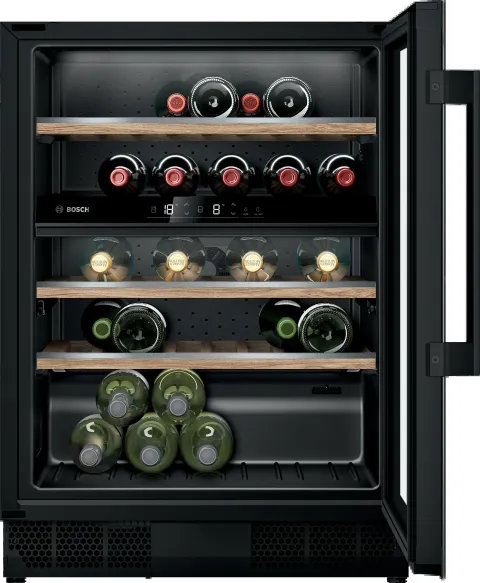
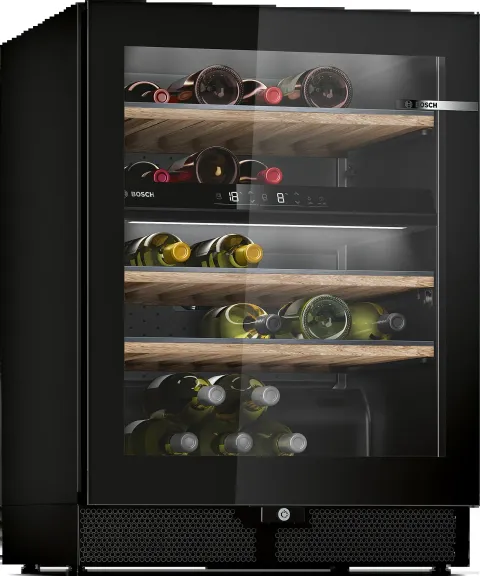
Line up the Bosch KUW21AHG0 and the Bosch KWK16ABGB and you are looking at the same machine wearing two different jackets. Both hold 44 bottles across 2 temperature zones running 5 to 20°C. Both measure 38 dB, both sit in noise class C, both carry a G energy rating. The cabinets are nearly the same size too, 81.8 cm tall in both cases, 59.8 cm wide against 60.0 cm, 58.1 cm deep against 59.3 cm. The freestanding unit is 3.2 kg heavier, 44.7 kg versus 41.5 kg, which tracks: a freestanding cooler needs finished panels on every visible side, while a built-in unit only needs to look good from the front.
What you are actually paying the extra 490 EUR for is the built-in fitting: cabinetry integration, a front panel designed to sit flush with your kitchen units, hardware that lets it disappear into a run of cupboards. That is a real feature if you have a kitchen designed around it. It is not a performance upgrade.
The one place the built-in model does pull ahead is electricity, 130 kWh a year against the freestanding unit’s 142 kWh, a 9.2 percent edge. At 0.40 EUR per kWh that is 52.00 EUR a year against 56.80 EUR, a saving of 4.80 EUR annually. Divide the 490 EUR premium by that saving and you get about 102 years to break even, longer than either appliance, or its owner, will last. The running-cost gap is real but trivial. The purchase-price gap is the one that matters, and it buys a form factor, not a better machine.
Does size actually save you money per bottle?
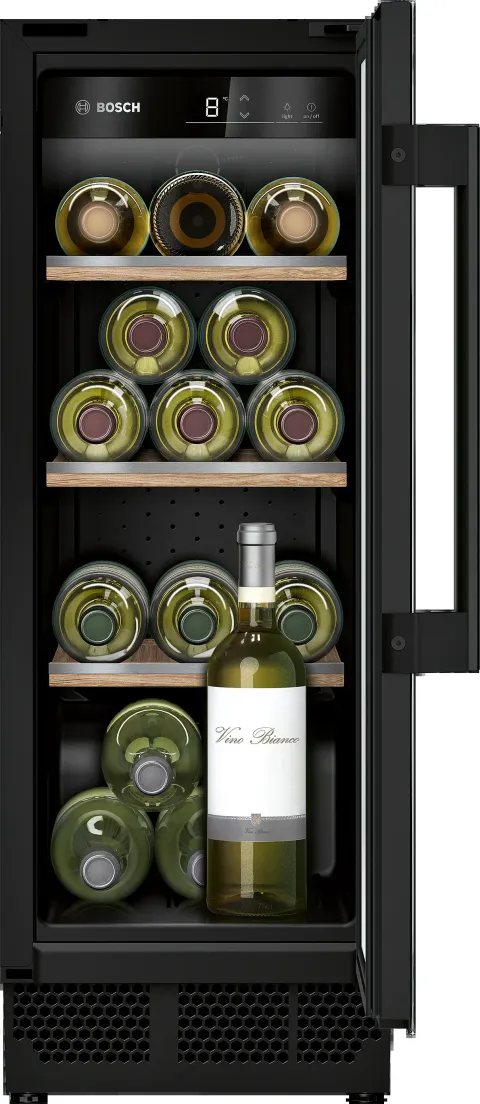
Yes, and by a lot. Across all four models, the price per bottle of storage falls steeply as capacity rises: 57.57 EUR per bottle on the 21-bottle KUW20VHF0, down to 44.30 EUR on the 44-bottle KUW21AHG0, 33.16 EUR on the 44-bottle KWK16ABGB, and 10.75 EUR on the 199-bottle KWK36ABGA, a 5.4 times drop from smallest to largest.
The pattern is the ordinary economics of a bigger box: a compressor, a shell, and a control board cost roughly the same to build whether the shelves inside hold 21 bottles or 199, so the fixed cost gets spread thinner as capacity grows. If you genuinely need more storage, or even suspect you might in a few years, the euro-per-bottle math says buy bigger now rather than upgrading twice.
| Model | Install type | Price (EUR) | Capacity (bottles) | Zones | Energy class | Annual kWh | Noise (dB) | EUR / bottle |
|---|---|---|---|---|---|---|---|---|
| KUW20VHF0 | Built-in | 1,209 | 21 | 1 | F | 100 | 38 | 57.57 |
| KUW21AHG0 | Built-in | 1,949 | 44 | 2 | G | 130 | 38 | 44.30 |
| KWK16ABGB | Freestanding | 1,459 | 44 | 2 | G | 142 | 38 | 33.16 |
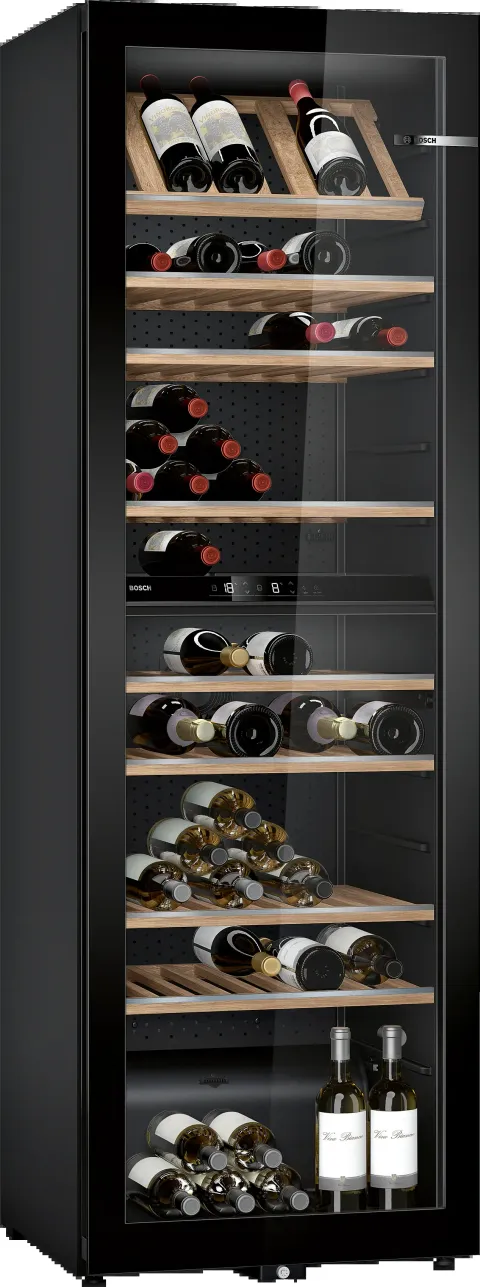
| KWK36ABGA | Freestanding (tower) | 2,139 | 199 | 2 | G | 155 | 38 | 10.75 |
Does noise tell you anything here?
Not in this lineup. All four coolers measure precisely 38 dB and sit in the same noise class C, regardless of price, capacity, or whether they are built in or freestanding. A machine holding 199 bottles hums exactly as loudly as one holding 21. That consistency suggests Bosch is running the same compressor and cabinet-engineering baseline across the whole wine-cooler range, which is convenient for you: it means you can stop treating noise as a decision factor here and focus on capacity, price, and install type instead.
Why is the biggest cooler rated worse than the smallest?
Here is the one figure that will mislead you if you read it too quickly. The 21-bottle KUW20VHF0 reaches energy class F. The 44-bottle KUW21AHG0, the 44-bottle KWK16ABGB, and the 199-bottle KWK36ABGA are all rated G, the bottom of the EU’s A-to-G scale. It is tempting to read that as “the bigger units are less efficient.” They are not, at least not per bottle stored.
Wine coolers fall under the same EU ecodesign and energy-labelling framework as household fridges and freezers, Regulation (EU) 2019/2016. The European Commission’s own product page for that regulation confirms the label for wine storage appliances also shows bottle capacity, because the letter grade is calculated against a size-adjusted reference threshold for absolute annual electricity use, not against electricity spent per bottle. That is why the small F-rated unit, using 100 kWh a year, still works out to 4.76 kWh per bottle per year, while the G-rated 199-bottle giant, using 155 kWh a year in total, needs only 0.78 kWh per bottle, six times less energy for every bottle it stores. On the badge, small wins. On the shelf-by-shelf math, big wins by a wide margin.
The honest takeaway is not that the label is broken, it is that it answers a different question than “which machine wastes less energy per bottle.” Don’t assume a worse letter means a worse machine for your actual use case: if you’re filling 199 bottle slots, the G-rated giant is doing far more efficient work per bottle than the F-rated model ever could.
So which one should you buy?
If you need a wine cooler that disappears into a run of kitchen cabinetry, the built-in premium is a real cost of a real feature, and now you know its size: 490 EUR here, and essentially nothing back on the electricity bill. Pay it with your eyes open. If cabinetry integration is not a requirement, or you think you will want more than 44 bottles eventually, the freestanding and larger models are the better euro-for-euro picks in this lineup, both on sticker price and on cost per bottle stored. Browse the full range on the wine coolers category page, or run any two models side by side in the comparison tool before you commit.
Appliances in this analysis
Bosch
Serie 6 KUW20VHF0
Bosch
Serie 6 KUW21AHG0
Bosch
Serie 6 KWK16ABGB
Bosch
Serie 6 KWK36ABGA
Related categories
Frequently asked questions
Does Bosch's built-in wine cooler actually perform better than the freestanding version? +
No. The two 44-bottle models (KUW21AHG0 built-in, KWK16ABGB freestanding) share the same 2 temperature zones, the same 5 to 20°C range, the same 38 dB noise, and the same G energy class. The built-in model uses slightly less electricity, 130 kWh a year against 142 kWh, but that saves only about 4.80 EUR a year, nowhere near enough to offset a 490 EUR higher price.
Why is Bosch's biggest wine cooler rated worse than its smallest? +
The EU's fridge-and-freezer energy label, which also covers wine storage appliances under Regulation (EU) 2019/2016, grades absolute annual electricity use against a size-adjusted reference, not electricity used per bottle stored. The 21-bottle KUW20VHF0 (100 kWh a year) reaches class F. The 44- and 199-bottle models, despite using far less electricity per bottle of capacity, land at G, the bottom of the scale.
Do wine coolers carry an EU energy label at all? +
Yes. Wine storage appliances fall under the same regulation as household fridges and freezers, and the European Commission's own product page for that regulation states the label also shows bottle capacity.
Is a bigger wine cooler cheaper per bottle of storage? +
Sharply so across this lineup. The smallest model costs 57.57 EUR per bottle of capacity. The largest costs 10.75 EUR per bottle, more than five times less, even though its sticker price is the highest of the four.
Sources
- Bosch Serie 6 KUW20VHF0 product page
- Bosch Serie 6 KUW21AHG0 product page
- Bosch Serie 6 KWK16ABGB product page
- Bosch Serie 6 KWK36ABGA product page
- EPREL registration 380150 (KUW20VHF0)
- EPREL registration 274363 (KUW21AHG0)
- EPREL registration 1477432 (KWK16ABGB)
- EPREL registration 274392 (KWK36ABGA)
- European Commission: fridges and freezers (covers wine storage appliances, Reg. 2019/2016)
More from the blog