Watts Don't Tell You How Much Steam an Iron Makes
The iron with the highest wattage in our database delivers the least continuous steam. Power draw and steam output are two different specs.
By Nora Fischer · Last updated 19 July 2026
Researched and drafted with AI language-model assistance from CompareHomeAppliances' own verified spec database and cited public sources, per our AI-content disclosure.
The Krups SteamForce Pro DW9520 draws 3,200 watts, the highest power figure of any iron in our database, and no other model even discloses a wattage to compare it to. Yet on continuous steam output, the one number that actually predicts how an iron performs on a real ironing pile, Krups sits at the bottom: 75 grams per minute, against 120, 180, and 215 g/min for the three steam-generator models that publish a figure. Watts tell you how fast an iron heats up. They do not tell you how much steam it can push out and keep pushing.
Key takeaways:
- Krups SteamForce Pro DW9520 has by far the highest disclosed wattage in our dataset, 3,200W, yet the lowest continuous steam output of the four models with a published figure, 75 g/min.
- Philips PerfectCare 8000 PSG8200 leads on every steam metric we track: 215 g/min continuous output, a 750g boost, and a 1,400ml tank.
- Krups is the only standard “steam” iron in this set, not a steam-generator, and its 350ml water tank is roughly a quarter the size of the steam-generator models’ 1,100-1,500ml tanks, which is the mechanical reason it cannot sustain the same flow.
- Continuous output and steam boost are separate specs. Rowenta Compact Steam Pro DG7623 publishes only a 325g boost figure with no continuous rate, so it cannot be ranked on the chart below.
- Among the four models in our set with a published price, Krups is the cheapest at 130.99 EUR despite having by far the most powerful-sounding spec sheet; Tefal is the most expensive at 299.99 EUR.
Why does the highest-wattage iron make the least steam?
Wattage measures electrical power draw, mostly how quickly a heating element brings water to boiling temperature and keeps it there. It says nothing about how much water the iron can turn into steam per minute, because that depends on the size and design of the water reservoir feeding the element, not on how many watts are pushing the heat.
Krups’ SteamForce Pro DW9520 packs a 3,200W element into a 350ml onboard tank, the smallest in our set. That tank sits inside the iron itself and heats a small volume of water on demand. It is genuinely capable of a strong 300g boost for stubborn creases, but it cannot maintain a high continuous flow, because there simply is not a large enough reservoir behind the element to keep feeding it. No competing model in our dataset even lists a wattage figure, which is itself worth noticing: none of the three steam-generator irons market their power draw at all. They market their steam output instead, because that is the number that actually describes what the iron does to a shirt.
What is the difference between continuous steam and a steam boost?
These are two different specs, measured two different ways, and shoppers often read one as if it were the other.
Continuous steam output (grams per minute) is the steady flow an iron sustains through an ordinary session: shirt after shirt, minute after minute. It is the number that determines how fast you get through a basket of laundry.
Steam boost (grams, as a single figure) is a short, one-off burst the iron can release on demand, aimed at a stubborn crease or a heavy fold. It does not repeat continuously; it is a spike, not a rate.
| Model | Type | Power (W) | Continuous steam (g/min) | Steam boost (g) | Water tank (ml) | Price (EUR) |
|---|---|---|---|---|---|---|
| Krups SteamForce Pro DW9520 | Steam (not generator) | 3,200 | 75 | 300 | 350 | 130.99 |
| Braun CareStyle Compact IS2132 | Steam-generator | N/A | 120 | 400 | 1,500 | 146.00 |
| Tefal Pro Express Vision GV9810 | Steam-generator | N/A | 180 | 680 | N/A | 299.99 |
| Rowenta Compact Steam Pro DG7623 | Steam-generator | N/A | N/A | 325 | 1,100 | 182.99 |
| Philips PerfectCare 8000 PSG8200 | Steam-generator | N/A | 215 | 750 | 1,400 | N/A |
Rowenta’s Compact Steam Pro DG7623 is the clearest illustration of why the two specs should not be conflated: it publishes a 325g boost figure but no continuous output at all, so we cannot place it on the chart below or compare it to the other three on sustained flow, only on burst power.
Why does a steam-generator hold more water than a standard steam iron?
The gap in tank size explains the gap in steam output, and it comes down to category, not brand. A standard steam iron like the Krups SteamForce Pro heats a small amount of water inside the iron head itself, in a 350ml onboard chamber. That chamber is compact by design, so the iron stays light and easy to move, but it puts a hard ceiling on how much steam can be generated at once.
A steam-generator iron, which is what the Braun, Tefal, Rowenta, and Philips models in our set all are, separates the water reservoir from the iron head entirely. A pressurized boiler sits in a base unit connected by a hose, holding 1,100 to 1,500ml in our dataset, roughly three to four times Krups’ tank. That larger, pressurized reservoir is what lets Braun, Tefal, and Philips sustain 120 to 215 g/min continuously rather than working from a small onboard chamber. It is a genuine category difference in engineering, not a marketing gap between similar machines.
Does price track steam output?
Not cleanly. Among the four models in our set with a published price, Krups is the cheapest at 130.99 EUR, Braun sits at 146.00 EUR, Rowenta at 182.99 EUR, and Tefal is the most expensive at 299.99 EUR. Tefal’s price is over double Krups’, and its continuous output (180 g/min) is more than double Krups’ as well (75 g/min), so that pairing tracks. But Krups is also the cheapest of the four despite carrying the highest wattage figure in the whole dataset, a spec that sounds premium on a box but predicts nothing about steam delivery here. Philips has no published price in our database, so it cannot be placed in this price comparison, but it leads every steam metric it does disclose.
Is a steam-generator iron worth the bigger tank?
If you iron in real volume, business shirts every week, bedding, stiff cotton, the data favors the steam-generator category outright: Braun, Tefal, and Philips all out-steam the standard Krups iron on continuous flow, and their larger tanks mean fewer mid-session refills. Philips PerfectCare 8000 PSG8200 is the standout on paper, leading on continuous output (215 g/min), boost (750g), and tank size (1,400ml) at once, though its price is not published in our database, so weigh that against a verified listing before deciding.
If you only iron occasionally, a shirt here, a crease there, the smaller Krups SteamForce Pro is lighter, cheaper at 130.99 EUR, and still delivers a real 300g boost when you need one. Its low continuous rate rarely matters on a small pile.
Either way, do not let a wattage figure alone talk you into or out of a purchase. Compare the continuous steam and tank size figures in the irons category directly, or put two specific models side by side in our compare tool before you buy.
Appliances in this analysis
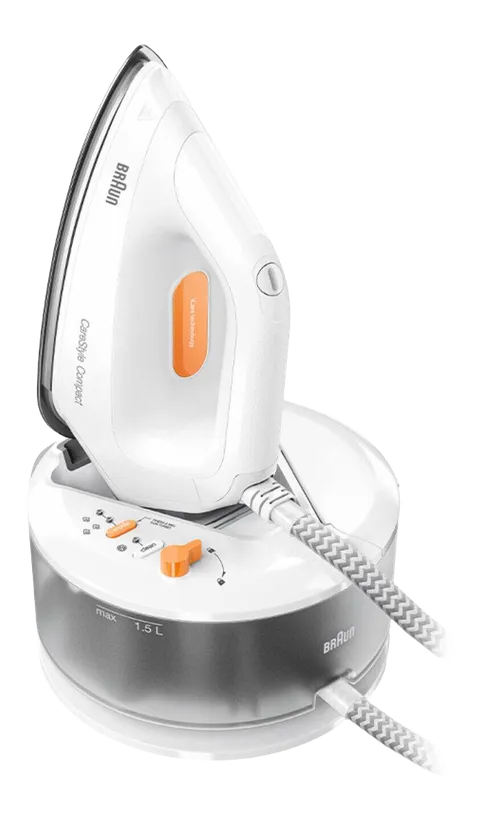
Braun
CareStyle Compact IS 2132 WH
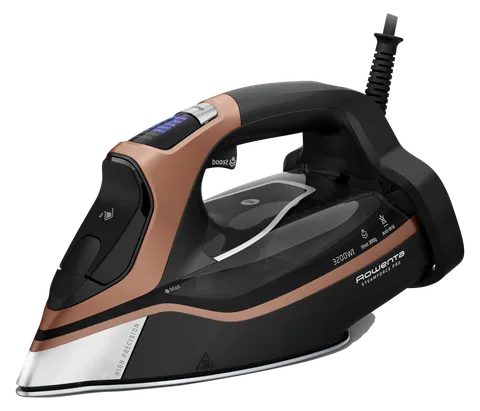
Krups
Steamforce Pro DW9520
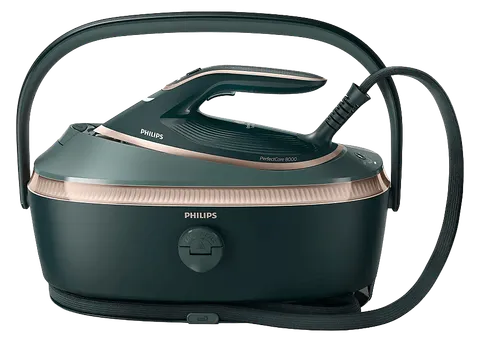
Philips
PerfectCare 8000 Series PSG8200/70
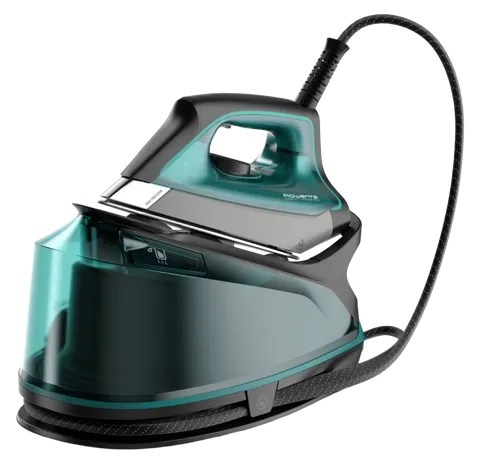
Rowenta
Compact Steam Pro DG7623
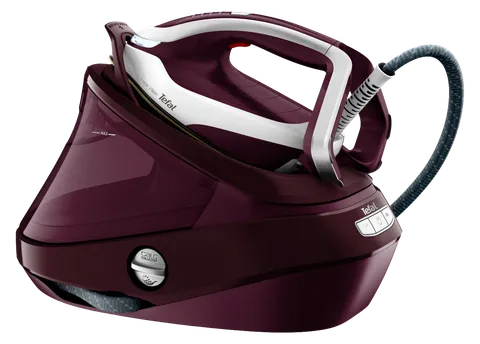
Tefal
Pro Express Vision GV9810
Related categories
Frequently asked questions
Does a higher-wattage iron produce more steam? +
No, not in our dataset. The Krups SteamForce Pro DW9520 draws the most power of any iron we track, 3,200 watts, but produces the least continuous steam of the four models with published figures, 75 g/min, well below models that disclose no wattage at all and reach up to 215 g/min. Wattage measures how fast an iron heats, not how much steam it can sustain.
What is the difference between continuous steam output and a steam boost? +
Continuous steam output, in grams per minute, is what an iron sustains through an ordinary ironing session. A steam boost, in grams, is a short burst released on a stubborn crease. The Philips PerfectCare 8000 sustains 215 g/min continuously and can also fire a 750g boost, while the Rowenta Compact Steam Pro DG7623 publishes only a 325g boost with no continuous rate, so it cannot be ranked against the others on sustained steam.
Is a steam-generator iron worth it over a standard steam iron? +
For anyone ironing large loads or stiff fabrics regularly, the data points that way: all three steam-generator models with published continuous output in our set (Braun, Tefal, Philips) beat the one standard steam iron (Krups) on sustained flow, and their 1,100-1,500ml tanks mean far fewer refills mid-session. For occasional touch-ups, the smaller, cheaper standard iron is easier to store and still does the job.
Sources
More from the blog