Siemens's Quietest 9kg Dryer Isn't Its Most Expensive
Siemens's priciest 9kg dryer (1,359 EUR, class A) is 1 dB louder than the 1,089 EUR class-B model, and its energy payback runs about 25 years, not 6.7.
By Nora Fischer · Last updated 1 September 2026
Researched and drafted with AI language-model assistance from CompareHomeAppliances' own verified spec database and cited public sources, per our AI-content disclosure.
Siemens sells four 9kg tumble dryers right now, all in the same capacity tier, all registered on the current EU energy label. Pay the most for one and you do not get the quietest machine. The flagship WR47B2C40 costs 1,359 EUR and carries the top A energy class, but at 57 dB it runs one decibel louder than the WQ46B2D41, a 1,089 EUR class-B model sitting one rung below it. The quietest dryer in the group is the second-most-expensive one, not the flagship.
Key takeaways:
- The priciest Siemens 9kg dryer, the WR47B2C40 at 1,359 EUR (class A), runs at 57 dB, one decibel louder than the 1,089 EUR class-B WQ46B2D41 at 56 dB.
- The C-to-B step (WQ45H2BECO to WQ46B2D41, +100 EUR) cuts noise by 5 dB, the biggest drop of the three price steps, and saves 14.98 EUR a year in electricity, paying back the premium in about 6.7 years.
- The B-to-A step (WQ46B2D41 to WR47B2C40, +270 EUR) saves only 10.81 EUR a year, a roughly 25-year payback, longer than a dryer’s realistic working life.
- The first step up, WQ33G2D41 to WQ45H2BECO (+160 EUR), changes nothing on the electricity bill: both use 1.10 kWh per cycle, per their EPREL registrations.
- Noise across the four models spans 7 dB, from 63 down to 56 and back up to 57, and does not move in a straight line with price.
What do the numbers actually look like across the four models?
| Model | Price (EUR) | Energy class | Cycle energy (kWh, EPREL) | Noise (dB) | Annual electricity cost* |
|---|---|---|---|---|---|
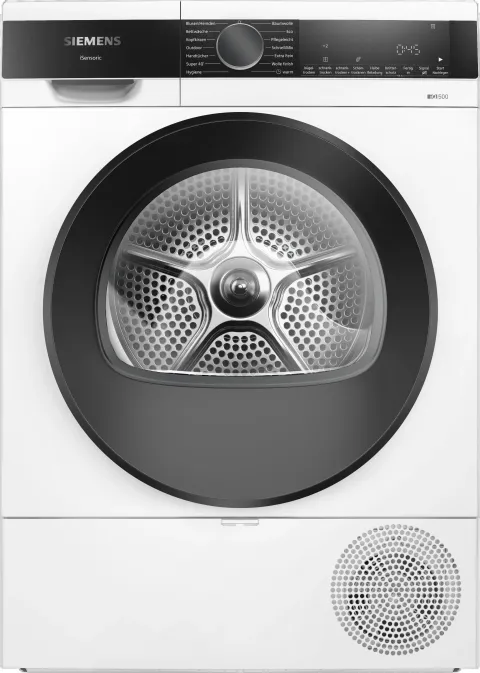
| Siemens iQ500 WQ33G2D41 | 829 | C | 1.10 | 63 | 91.52 EUR |
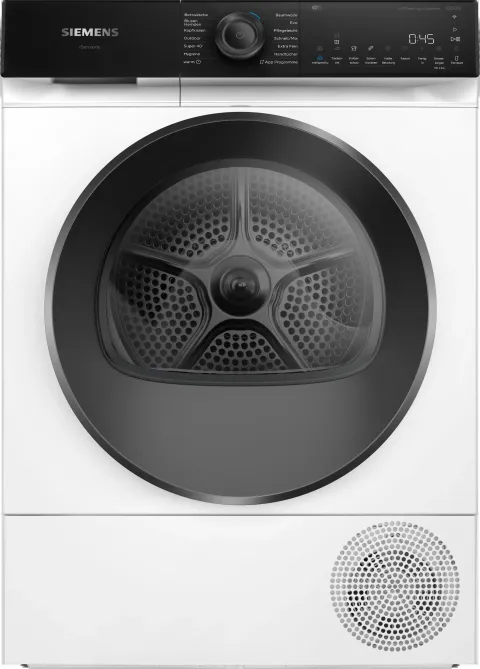
| Siemens iQ500 WQ45H2BECO | 989 | C | 1.10 | 61 | 91.52 EUR |
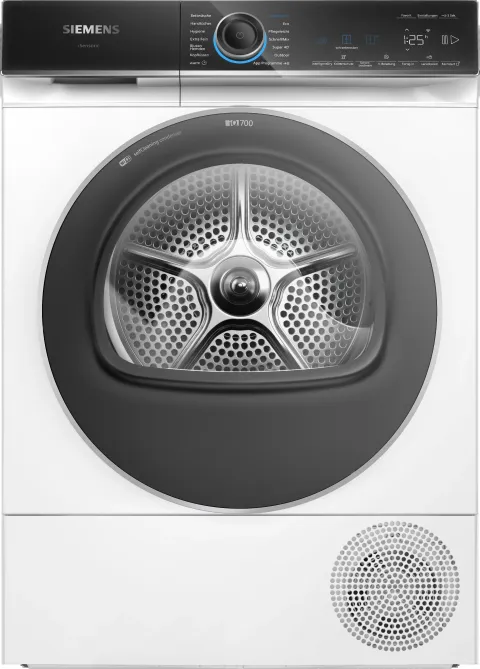
| Siemens iQ700 WQ46B2D41 | 1,089 | B | 0.92 | 56 | 76.54 EUR |
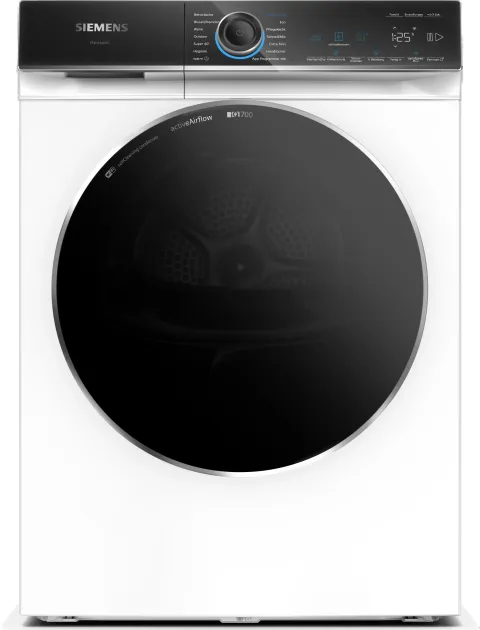
| Siemens iQ700 WR47B2C40 | 1,359 | A | 0.79 | 57 | 65.73 EUR |
*Annual cost = cycle energy x 208 cycles a year x 0.40 EUR per kWh, the site’s own running-cost basis for tumble dryers.
Price and energy class come from our own appliance database. The cycle energy figure, the kWh each machine actually draws per dry, is not one of our own database fields for these four; it comes straight from each model’s EPREL registration, the EU’s own product registry, flagged here as a manufacturer-reported figure rather than something we measured ourselves.
Where does the extra money actually go, step by step?
Buy up through this lineup one model at a time and the three steps behave very differently.
Step one, WQ33G2D41 to WQ45H2BECO, adds 160 EUR (+19.3 percent) and buys nothing on the energy side. Both machines are class C, both draw 1.10 kWh a cycle, so the annual electricity cost is identical at 91.52 EUR either way. What you get is 2 dB less noise (63 to 61) and whatever other iQ500 trim differences Siemens has not itemised in our database. If your budget is tight, this step is the one to skip.
Step two, WQ45H2BECO to WQ46B2D41, adds 100 EUR (+10.1 percent), the cheapest of the three steps in euros, and does the most work. The energy class moves from C to B, cycle energy drops from 1.10 kWh to 0.92 kWh, and noise falls by 5 dB (61 to 56), the single biggest quiet gain in the lineup. That 0.18 kWh-per-cycle saving is worth 14.98 EUR a year at 208 cycles and 0.40 EUR per kWh, so the 100 EUR premium pays for itself in about 6.7 years, well inside a dryer’s normal service life. Cheapest step, biggest noise drop, real payback: this is the one worth paying for.
Step three, WQ46B2D41 to WR47B2C40, adds 270 EUR (+24.8 percent) for the top A energy class, and the return thins out fast. Cycle energy edges down from 0.92 kWh to 0.79 kWh, worth 10.81 EUR a year, so the 270 EUR premium takes about 25 years to earn back, a horizon that outlives the machine. And noise does not improve for the money: it rises 1 dB, from 56 to 57. The A-class badge here does not buy a quieter dryer, it buys a slightly louder one that also costs more to earn back.
Which model is actually the quiet one?
Read the bars left to right in price order and the line is not straight: noise drops from 63 to 61 to 56 dB across the first three models, then rises back to 57 dB on the most expensive one. We are not told why the class-B model is quieter than the class-A model above it; Siemens’s own product pages do not give a drum or motor explanation for the gap, so we are reporting the measured figures, not guessing at the engineering behind them.
Does a higher energy class always mean quieter?
Not on this evidence. Energy class describes electricity use, not sound, and the two only happen to move together for the middle two steps in this lineup. Treat the letter and the decibel figure as two separate questions, and check both before paying a premium for either one. Our guide to the EU energy label covers how the class letter itself is set.
Worth flagging too: this is one brand’s own internal 9kg lineup, not a claim about tumble dryers generally. Other brands in our catalog, and other capacity tiers even within Siemens, could easily behave differently. And these four all sit on the EU’s current 2023 A-to-G rescale; some other dryer brands we track still display the older A+++ scale, which is not directly comparable letter for letter. If you are checking a badge on a dryer outside this lineup, The Five-Minute Check Before You Pay for an ‘A+++’ Dryer walks through telling the two scales apart before you compare classes across brands.
What tariff assumptions sit behind these payback numbers?
The 91.52, 76.54 and 65.73 EUR annual figures above all rest on the same basis: 0.40 EUR per kWh and 4 dry cycles a week, 208 cycles a year. That is CompareHomeAppliances’ own stated approximation for a German household tariff, not a universal number, and it is the same assumption behind our running-cost tool. Plug in your own tariff and laundry habits there if yours differ; the euro totals will shift, but the ranking between these four models, and the fact that the C-to-B step pays back roughly four times faster than the B-to-A step, will not.
So which of the four should you buy?
If quiet operation and a fast energy payback both matter, the WQ46B2D41 is the sensible buy: 1,089 EUR, class B, 56 dB, and a 100 EUR step up from the cheaper class-C model that pays for itself in under seven years. Paying a further 270 EUR for the class-A WR47B2C40 buys a top-tier badge and a slightly louder machine, with a payback period that outlasts the dryer. The only shopper who should skip the WQ46B2D41 entirely is one who genuinely does not care about noise or running cost and wants the lowest sticker price, in which case the base WQ33G2D41 at 829 EUR is the honest choice, not the mid-tier WQ45H2BECO, which costs 160 EUR more for the same energy bill and only a marginal noise gain.
Appliances in this analysis
Siemens
iQ500 WQ33G2D41
Siemens
iQ500 WQ45H2BECO
Siemens
iQ700 WQ46B2D41
Siemens
iQ700 WR47B2C40
Related categories
Frequently asked questions
Does a higher energy class mean a quieter tumble dryer? +
Not necessarily. Among Siemens's own four 9kg dryers, the class-A model (WR47B2C40, 57 dB) is one decibel louder than the class-B model one tier below it (WQ46B2D41, 56 dB), which is also 270 EUR cheaper. The energy letter tracks electricity use, not noise.
How much does one energy-class letter actually cost in this lineup, and does it pay back? +
Moving from C to B costs 100 EUR and saves about 14.98 EUR a year in electricity, a payback of roughly 6.7 years. Moving from B to A costs 270 EUR and saves only about 10.81 EUR a year, a payback of roughly 25 years, longer than a dryer's realistic working life.
Are all tumble dryer energy labels on the same scale? +
No. These four Siemens models are registered under the EU's current 2023 A-to-G rescale, but some other dryer brands in our catalog still display the older A+++ scale. The two scales are not comparable letter for letter; see The Five-Minute Check Before You Pay for an 'A+++' Dryer for how to tell which one you are looking at.
What tariff and usage assumptions sit behind the running-cost numbers here? +
0.40 EUR per kWh and 4 dry cycles a week (208 cycles a year), which is CompareHomeAppliances' own stated approximation for a German household and the same basis our running-cost tool uses. A different tariff or laundry frequency will move the euro figures, though not the ranking between models.
Sources
- Siemens iQ500 WQ33G2D41 product page
- Siemens iQ500 WQ45H2BECO product page
- Siemens iQ700 WQ46B2D41 product page
- Siemens iQ700 WR47B2C40 product page
- EPREL registration, Siemens WQ33G2D41 (energy consumption per cycle)
- EPREL registration, Siemens WQ45H2BECO (energy consumption per cycle)
- EPREL registration, Siemens WQ46B2D41 (energy consumption per cycle)
- EPREL registration, Siemens WR47B2C40 (energy consumption per cycle)
- European Commission, tumble dryers product list (Ecodesign/energy label)
More from the blog