A More Powerful Cooker Hood Doesn't Mean a Louder One
Extraction power in our cooker-hood data spans 266 to 600 cubic metres an hour, but maximum noise barely moves, staying within a 65 to 70 decibel band.
By Nora Fischer · Last updated 8 August 2026
Researched and drafted with AI language-model assistance from CompareHomeAppliances' own verified spec database and cited public sources, per our AI-content disclosure.
Seventeen Bosch cooker hoods in our database publish both an extraction rate and a maximum noise figure. The weakest pulls 266 cubic metres of air an hour; the strongest pulls 600, more than twice as much. The noise reading, measured the same way on every model, moves by just 5 decibels across that entire range, from 65 to 70. If you have been shopping on the assumption that more suction means more racket, our own numbers say otherwise.
Key takeaways:
- Extraction rate across the 17 hoods with both figures spans 266 to 600 m3/h (a 2.3x range), but maximum noise stays inside a 65 to 70 dB band, only 5 dB wide.
- The database’s most powerful hood, the 600 m3/h Bosch DLN87AC50, ties for the quietest reading at 65 dB; the weakest hood, at 266 m3/h, is tied for the loudest at 70 dB.
- Among 12 hoods with a listed price, cost per cubic metre of extraction ranges from 0.67 EUR to 3.49 EUR per m3/h, a 5.2x spread, so price is not tracking raw airflow.
- Range hoods carry a mandatory EU energy label (A+++ to G) in force since January 2015; the hob underneath one carries no energy label at all.
- That noise figure is measured at the hood’s highest fan speed, not the quieter setting most people actually cook on day to day.
Does a bigger extraction number mean a louder kitchen?
Look at the full set and the pattern (or lack of one) holds up. Here are all 17 Bosch hoods in our database that publish both figures, ranked by extraction rate:
| Model | Extraction rate (m3/h) | Max noise (dB) | Energy class | Price (EUR) | Type |
|---|---|---|---|---|---|
| DFL094A51 | 266 | 70 | A | N/A | Integrated |
| DFS067K51 | 392 | 68 | A | 969 | Integrated |
| DFR067A52 | 399 | 68 | A | 579 | Integrated |
| DWB67DN60 | 399 | 68 | A++ | N/A | Wall-mounted |
| DWB97DN60 | 399 | 68 | A++ | N/A | Wall-mounted |
| DWK85DK60 | 430 | 65 | A | 899 | Wall-mounted |
| DWK67FN60 | 431 | 68 | A+ | 979 | Wall-mounted |
| DWK87FN60 | 431 | 68 | A+ | 1059 | Wall-mounted |
| DBB67DP60 | 433 | 68 | A+ | N/A | Integrated |
| DBB97DP60 | 433 | 68 | A+ | 909 | Integrated |
| DWK91LT60 | 441 | 70 | A+ | 1539 | Wall-mounted |
| DRC97AQ50 | 459 | 68 | A | N/A | Ceiling |
| DRC99PS20 | 459 | 70 | A | N/A | Ceiling |
| DHL555BM | 460 | 68 | D | N/A | Integrated |
| DHL755BM | 468 | 68 | D | N/A | Integrated |
| DLN56AC50 | 570 | 68 | B | N/A | Integrated |
| DLN87AC50 | 600 | 65 | A | N/A | Integrated |
Sort that table by noise instead of extraction rate and the two loudest entries, at 70 dB, sit at opposite ends of the power range: 266 m3/h and 459 m3/h. The two quietest, at 65 dB, sit at 430 m3/h and 600 m3/h, the highest figure in the whole table. A shopper picking the strongest hood on the shelf is not, on this evidence, signing up for the loudest one.
Why doesn’t power translate to noise?
Our database does not capture duct diameter, motor design, or blade geometry, so it cannot tell you the engineering reason. What it can tell you, honestly, is that extraction rate is the wrong spec to use as a noise proxy. If quiet operation matters to you, the maximum-noise figure on the label is the number to compare, not the m3/h rating next to it.
The energy-class column in the table above tells a similar story. DLN56AC50 pulls the second-highest volume of air, 570 m3/h, and rates only B. DHL555BM and DHL755BM sit in the middle of the power range and both rate D, the weakest class in this set. The database’s most powerful hood, at 600 m3/h, still manages an A. Extraction rate, energy class, and noise are three separate numbers on a Bosch spec sheet, and none of them predicts either of the other two.
Does paying more get you a stronger hood?
Not cleanly. Twelve hoods in our database publish both a price and an extraction rate:
| Model | Price (EUR) | Extraction rate (m3/h) | EUR per m3/h |
|---|---|---|---|
| DWP66BC50 | 399 | 598 | 0.67 |
| DBB65CC60 | 459 | 582 | 0.79 |
| DUL62FA51 | 239 | 250 | 0.96 |
| DUL63CC50 | 349 | 350 | 1.00 |
| DWB95CC30 | 599 | 594 | 1.01 |
| DFR067A52 | 579 | 399 | 1.45 |
| DWK85DK60 | 899 | 430 | 2.09 |
| DBB97DP60 | 909 | 433 | 2.10 |
| DWK67FN60 | 979 | 431 | 2.27 |
| DWK87FN60 | 1059 | 431 | 2.46 |
| DFS067K51 | 969 | 392 | 2.47 |
| DWK91LT60 | 1539 | 441 | 3.49 |
The cheapest hood per cubic metre of airflow, a 399 EUR wall-mounted DWP66BC50, moves 598 m3/h. The most expensive per cubic metre, a 1,539 EUR wall-mounted DWK91LT60, moves less air, 441 m3/h, for close to four times the price per unit of extraction. That gap of 0.67 EUR to 3.49 EUR per m3/h, a 5.2x spread, is not explained by installation type either: both of those hoods are wall-mounted. What the higher-priced tier is more likely buying is finish, control layout, filter type, and lighting quality, none of which our schema captures as a single comparable number, so treat that as an honest gap in what this data can tell you rather than a conclusion.
Why does a hood get an EU label but the hob underneath it doesn’t?
This is a genuine split in EU appliance rules, and it runs the opposite direction from what you might expect. Ecodesign Regulation 66/2014 covers ovens, hobs, and range hoods together, but energy labelling under that same framework has only ever been mandatory for ovens and range hoods, not hobs, according to the European Commission’s own product page. Range hoods have carried a real A+++ to G label since January 2015, built from four separate sub-ratings, each scored A to G on its own: fluid dynamic efficiency (how well the hood moves air per watt), lighting efficiency, grease filtering efficiency, and the same maximum-noise figure in the table above. If you have read our piece on hob wattage, you already know the hob directly beneath that same hood carries no energy label at all, gas or electric. Two appliances sold as a matched kitchen pair, one legally required to disclose an efficiency letter, the other exempt entirely.
What should you actually check before buying?
Not the extraction-rate number on its own, on this evidence. A few things our data can and cannot settle for you:
- Compare the maximum-noise figure directly, not the m3/h rating. Our table shows a hood can be both the most powerful and among the quietest, so a high extraction number is not a trade-off you have to accept.
- Treat that noise figure as a ceiling, not an everyday reading. It is measured at maximum fan speed; day-to-day use on a lower setting will be quieter than the label suggests, on every model.
- Check installation type against your kitchen layout, not just the spec sheet. Our extractor hoods category covers wall-mounted, integrated, and ceiling designs side by side, and type constrains price and duct routing more than raw airflow does.
- Price per m3/h is worth calculating yourself before assuming a pricier hood is a stronger one; our own 12-model spread shows it frequently is not.
Once you have a short list, our compare tool will line up extraction rate, noise, energy class, and price for any two hoods side by side, and the buying advisor can help narrow that list down in the first place.
Appliances in this analysis
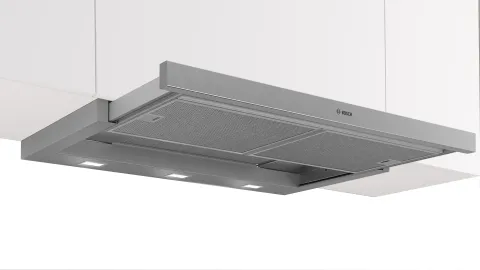
Bosch
Serie 4 DFL094A51
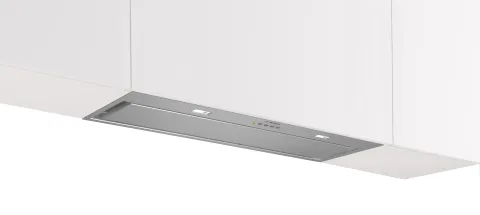
Bosch
Serie 6 DLN87AC50
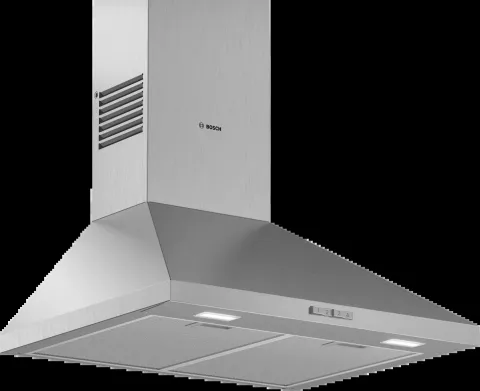
Bosch
Serie 2 DWP66BC50
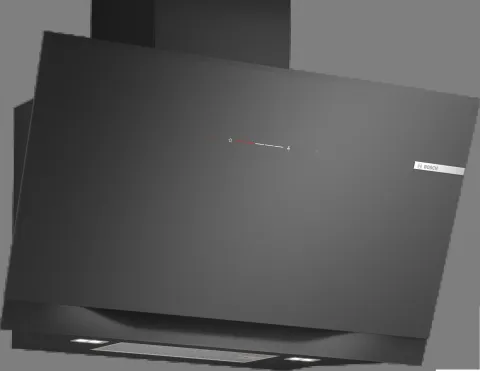
Bosch
Serie 8 DWK91LT60
Bosch
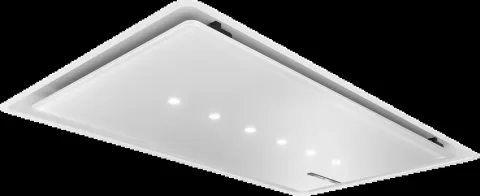
Serie 8 DRC99PS20
Bosch
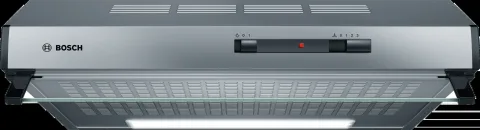
Serie 2 DUL62FA51
Related categories
Frequently asked questions
Does a higher extraction rate mean a louder cooker hood? +
Not in our own data. Seventeen Bosch hoods in our database publish both figures, and extraction rate ranges from 266 to 600 cubic metres an hour (a 2.3x spread) while maximum noise stays within a 65 to 70 decibel band, only 5 dB wide. The weakest hood, at 266 m3/h, is tied for the loudest at 70 dB; the strongest, at 600 m3/h, is tied for the quietest at 65 dB. Extraction power alone does not predict how loud a hood will be.
Do cooker hoods carry an EU energy label the way fridges or dishwashers do? +
Yes, and this is a real point of difference from the hob underneath one. Energy labelling has been mandatory for range hoods since January 2015, on a scale from A+++ to G, built from four separate sub-ratings: fluid dynamic efficiency, lighting efficiency, grease filtering efficiency, and noise, each scored A to G on its own. Hobs, by contrast, carry no energy label at all under the same regulation, as we covered in our piece on hob wattage.
Does paying more for a cooker hood get you more extraction power? +
Not reliably. Among the 12 hoods in our database with a listed price, the cost per cubic metre of extraction ranges from 0.67 EUR to 3.49 EUR per m3/h, a 5.2x spread. The cheapest per unit of airflow, a 399 EUR wall-mounted model at 598 m3/h, moves nearly as much air as the most expensive per unit, a 1,539 EUR wall-mounted model at 441 m3/h, for well under a third of the price. Price is buying something other than raw extraction capacity.
What does the 'maximum noise' figure on a hood's spec sheet actually measure? +
The EU's own energy label defines it as the airborne acoustical sound power emission at the hood's maximum fan speed under normal use, not at whatever lower setting you actually cook on day to day. It is the only noise figure manufacturers are required to disclose and the only one you can compare model to model, but treat it as a worst-case boost-mode number, not what you will hear during routine simmering.
Sources
More from the blog