Same A+ Label, 15 Decibels Apart in a Portable AC
Two portable air conditioners share the identical A+ energy label. One is 15 decibels louder. The letter tells you nothing about noise.
By Nora Fischer · Last updated 27 August 2026
Researched and drafted with AI language-model assistance from CompareHomeAppliances' own verified spec database and cited public sources, per our AI-content disclosure.
Say you are choosing between two portable air conditioners for a bedroom, and both carry the same A+ energy label. You would reasonably expect them to perform about the same. They do not. The Bosch Cool 4000 and the DeLonghi Pinguino GentleJet are both rated A+ in our air conditioners database, and the Bosch runs at 64 decibels while the DeLonghi runs at 49. That is a 15 decibel gap, roughly the difference between a refrigerator humming in the next room and a quiet conversation across a table, sitting behind one identical letter.
Key takeaways:
- The Bosch Cool 4000 and the DeLonghi Pinguino GentleJet both carry an A+ energy label but differ by 15 dB (64 dB versus 49 dB), a gap the label cannot show because it only ranks efficiency within the same class.
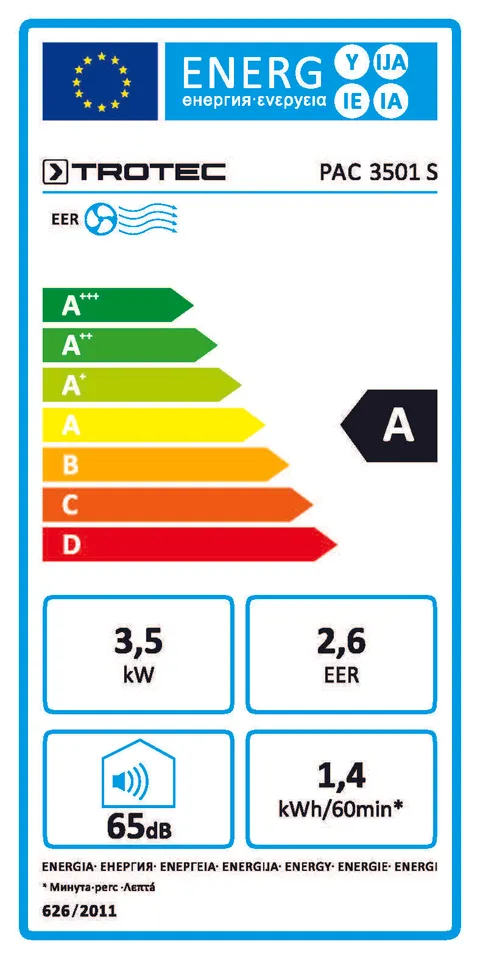
- Moving up a full letter, from A to A+, bought no quiet in this data: the A-rated Klarstein Aero Ring 9K (64 dB) and Trotec PAC 3501 S (65 dB) are as loud as, or louder than, the A+-rated Bosch (64 dB).
- The one quiet unit, the DeLonghi at 49 dB, is also the most expensive (979.90 EUR) and highest-capacity (12,000 BTU/h) unit in our data, so its quiet cannot be cleanly separated from its price and size.
- Claimed room-size-per-BTU ranges from about 253 to 290 BTU per square metre across four brands that publish the figure, a roughly 15 percent spread, meaning a “12,000 BTU” spec is not a fixed room-size promise.
- Air conditioners still use the legacy A+++ to G energy scale, not the rescaled A to G ladder now used for fridges and washing machines, so the “A+” here sits on a different measuring stick entirely.
Why does an identical A+ label hide a 15-decibel gap?
The EU energy label is a relative ranking. It tells you how a unit’s energy consumption compares to other units registered in the same class, on the same test cycle. It was never built to describe how the unit sounds while it runs. That is the whole story behind the Bosch and DeLonghi sitting on the same A+ rung: both meet whatever consumption bar the class requires, and the label stops there. One happens to be 8,872 BTU/h and the other 12,000 BTU/h, different compressors, different fan designs, different acoustic engineering, and none of that shows up on the sticker.
Fifteen decibels is not a rounding error. The decibel scale is logarithmic, so each 10 dB step reads as roughly a doubling of perceived loudness. A 15 dB gap is the kind of difference you notice within seconds of switching a unit on, and it is exactly the spec a shopper buying for a bedroom or a home office needs, yet it is invisible on the box both machines share.
Does going from A to A+ buy you a quieter unit?
Not in this data. Look at what the ”+” actually bought here.
Two energy classes, four units: the A-rated pair (64 to 65 dB) and the A+-rated Bosch (64 dB) land in the same noise band. Only the A+-rated DeLonghi breaks away, and it is also the priciest, highest-capacity unit in the set.
The Bosch Cool 4000 matches the Klarstein Aero Ring 9K’s noise output exactly, 64 dB, despite carrying a letter that is supposed to mark it as more efficient. The Trotec PAC 3501 S, also A-rated, is louder still at 65 dB. If you shopped by letter alone, you would rank the Bosch above both on efficiency and learn nothing about the fact that it sits in the same noise band as the units it is supposedly a grade ahead of.
The DeLonghi is the outlier, and it is worth being honest about why. It is also the most expensive unit here at 979.90 EUR and the highest-capacity at 12,000 BTU/h. A larger, pricier compressor assembly can be engineered for quieter operation more easily than a smaller one, so the 49 dB figure may reflect that build rather than anything specific to the A+ label. We cannot separate label, price and capacity as causes with five data points. What we can say is that the label itself did not predict the outcome: two A+ units differ by 15 dB, and two A-rated units are no louder than the A+-rated Bosch.
The full comparison
| Model | Price | Energy class | Noise | Cooling capacity | Claimed room size |
|---|---|---|---|---|---|
| Bosch Cool 4000 | N/A | A+ | 64 dB | 8,872 BTU/h | 35 m² |
| Comfee MPPH-08CRN7 | 319 EUR | N/A | N/A | 8,000 BTU/h | 28 m² |
| DeLonghi Pinguino GentleJet | 979.90 EUR | A+ | 49 dB | 12,000 BTU/h | N/A |
| Klarstein Aero Ring 9K | 459.99 EUR | A | 64 dB | 9,000 BTU/h | 31 m² |
| Trotec PAC 3501 S WiFi | N/A | A | 65 dB | 12,000 BTU/h | 46 m² |
Neither the Bosch’s price nor the Trotec’s price is published, and Comfee does not publish an energy class or a noise figure at all. Where a value is missing, we leave it missing rather than guess. That gap is itself useful: it means a shopper cannot compare all five units on every axis, only on the axes each brand chose to disclose.
Why is a portable air conditioner’s label harder to compare than a fridge’s?
Fridges, dishwashers and washing machines were rescaled onto a single A to G ladder in 2021, a change we covered in what the energy class label actually means across appliance categories. Air conditioners were left out of that rescale. They still carry the older label that runs from A+++ at the top down through G, the same scale ovens and tumble dryers use.
That matters beyond the usual warning against comparing letters across categories. An air conditioner’s “A+” is not only incomparable to a rescaled fridge’s “A”, it sits on a scale that was never rebased to reflect how far cooling technology has moved on. For the mechanics of the label and why the letter alone is not a like-for-like comparison, see our guide to the EU energy label.
Does “12,000 BTU” mean the same room size across every brand?
Not quite, though the gap here is a supporting note rather than a second headline. Bosch claims its 8,872 BTU/h unit covers 35 square metres, about 253 BTU per square metre. Comfee claims 8,000 BTU/h for 28 square metres, about 286 BTU per square metre. Klarstein claims 9,000 BTU/h for 31 square metres, about 290 BTU per square metre. Trotec claims 12,000 BTU/h for 46 square metres, about 261 BTU per square metre. That is a spread of roughly 253 to 290 BTU per square metre, about 15 percent, across brands making similar efficiency claims. DeLonghi does not publish a room-size figure at all for its 12,000 BTU/h unit. A raw BTU number is not a standardized room-size promise. Check the manufacturer’s own claimed coverage for the room you actually have, rather than assuming two units with the same BTU rating will handle the same space.
This finding rests on five portable air conditioners, all monobloc units, all currently in our database. The pattern, same label, different noise, is real and verifiable within this set, but it is a statement about these five units, not about the wider EU air-conditioner market.
What this means if you are buying
Do not let the energy-class letter stand in for noise. If you are choosing a portable air conditioner for a room where quiet matters, a bedroom, a nursery, a home office on a video call, check the decibel figure directly and treat the energy letter as what it is: a ranking of energy use against same-class peers, not a proxy for how the unit sounds. Two units carrying the same A+ can differ by 15 dB, and an A-rated unit can be no louder, or louder, than one rated a full letter higher. Use the comparison tool to put noise figures for specific models side by side before you decide, and check the manufacturer’s own claimed room size against the space you actually need to cool rather than the BTU number alone.
Appliances in this analysis
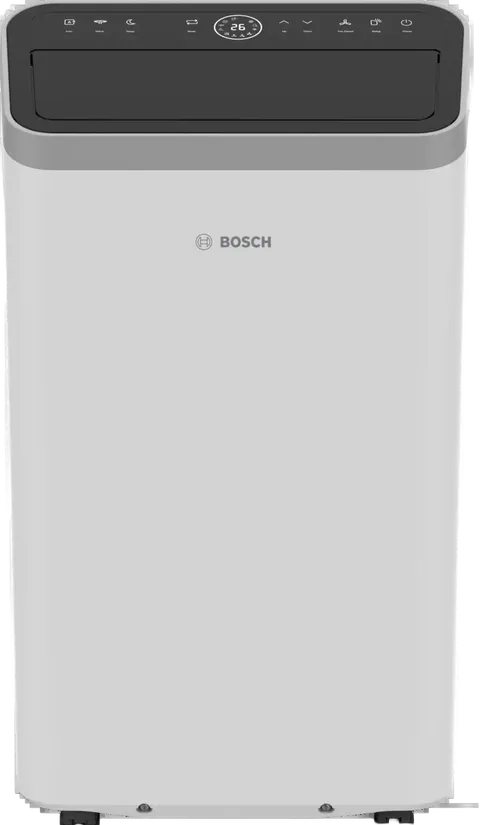
Bosch
Cool 4000 (C4000-EU)
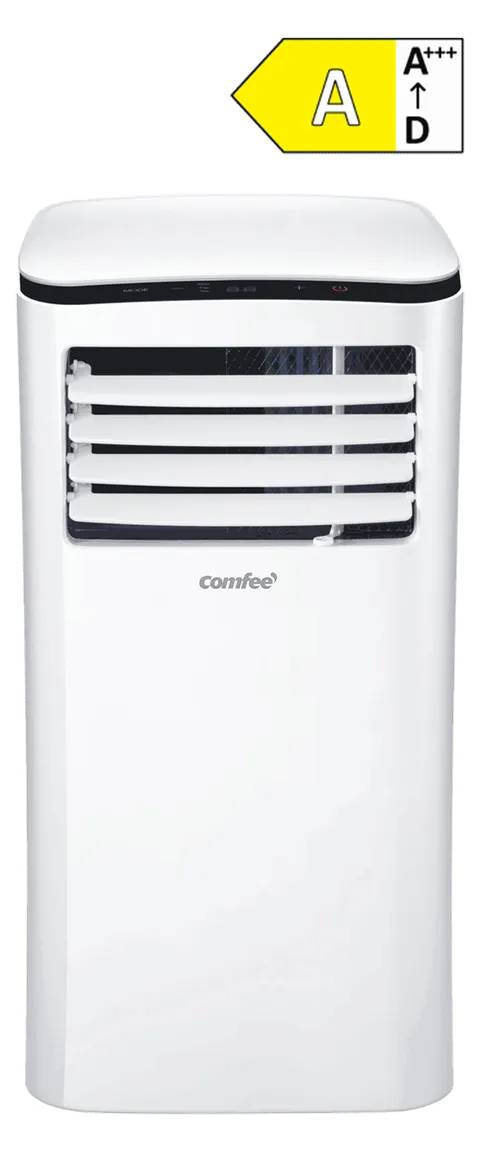
Comfee
MPPH-08CRN7 Eco Friendly Pro
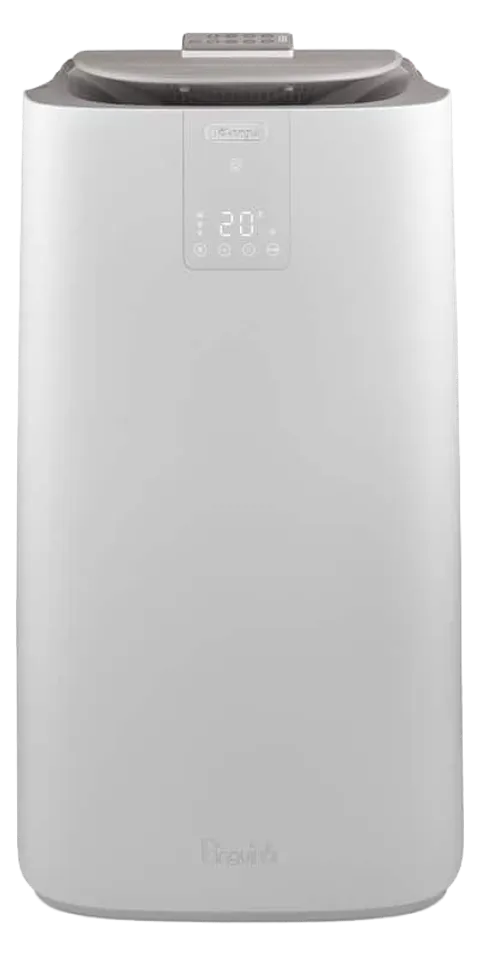
De'Longhi
Pinguino GentleJet PACAP120GENTLEJET
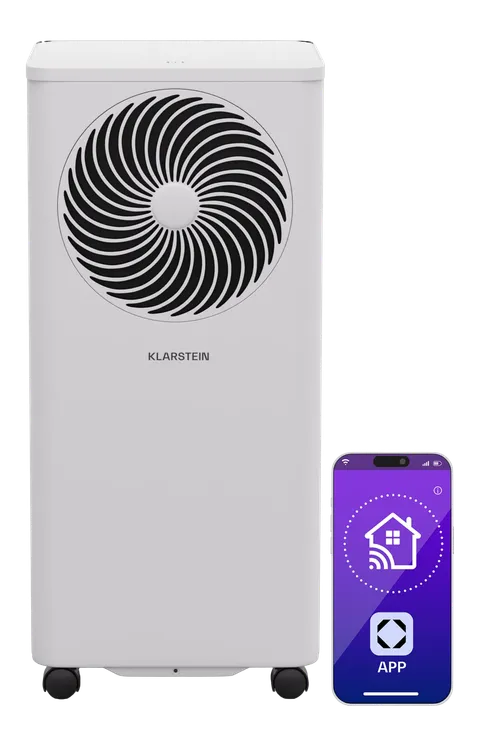
Klarstein
Aero Ring 9K
Trotec
PAC 3501 S WiFi
Related categories
Frequently asked questions
Does a higher energy class mean a quieter air conditioner? +
Not based on what we can verify. The Bosch Cool 4000 and the DeLonghi Pinguino GentleJet both carry an A+ label, yet the Bosch runs at 64 dB and the DeLonghi at 49 dB, a 15 decibel gap. Going from A to A+ did not buy quiet either: the A-rated Klarstein Aero Ring 9K (64 dB) and Trotec PAC 3501 S (65 dB) are just as loud as, or louder than, the A+-rated Bosch. The energy letter tells you how a unit compares to same-class peers on energy use. It says nothing about the sound it makes.
What does BTU mean for a portable air conditioner's cooling capacity? +
BTU per hour (BTU/h) measures how much heat the unit can remove from a room each hour, and it is the spec manufacturers use to size a unit against a room. But the room size a brand claims a given BTU figure will cover is not standardized. In our data, Bosch claims 8,872 BTU covers 35 square metres (about 253 BTU per square metre), while Klarstein claims 9,000 BTU covers only 31 square metres (about 290 BTU per square metre), a roughly 15 percent spread. Compare the manufacturer's own room-size claim, not the raw BTU number alone.
Are air conditioners rated on the same A to G scale as fridges and washing machines? +
No. Fridges, dishwashers and washing machines were rescaled in 2021 to a single A to G ladder. Air conditioners are still labeled on the older scale that runs from A+++ down through G, a scale that was never rescaled the way those other categories were. An A+ air conditioner and an A-rated fridge are not on the same measuring stick at all. See our guide to how the EU energy label actually works for the full breakdown.
What does a portable air conditioner's claimed room size actually reflect? +
It is the manufacturer's own estimate of the floor area its BTU output can cool under conditions that brand chose to test or model, not a figure set by a shared EU standard. That is why claimed room size per BTU varies from about 253 to 290 BTU per square metre across the units in our data, and why DeLonghi's Pinguino GentleJet does not publish a room-size claim at all for its 12,000 BTU unit. Treat it as one brand's estimate, not a portable number you can carry across manufacturers.
Sources
More from the blog