Two Decibels Quieter Costs 210 Euros, Same Energy Class
A Bosch and a Siemens dishwasher share the same energy class and the same 65 kWh per 100 cycles. The only real difference: 2 decibels, 210 euros.
By Nora Fischer · Last updated 18 August 2026
Researched and drafted with AI language-model assistance from CompareHomeAppliances' own verified spec database and cited public sources, per our AI-content disclosure.
Paying more for a quieter dishwasher does not buy you a lower electricity bill, at least not reliably. The Bosch Serie 6 SMS6ZCI16E and the Siemens iQ300 SN23EW03ME make the point directly: same energy class B, same 65 kWh per 100 cycles, same 14 place settings, and the only meaningful difference on the spec sheet is 2 decibels, 40 dB against 42 dB. The Bosch costs 829 EUR. The Siemens costs 619 EUR. That is a 210 EUR gap, 34 percent, bought entirely by noise.
Key takeaways:
- The Bosch Serie 6 SMS6ZCI16E (40 dB, 829 EUR) and Siemens iQ300 SN23EW03ME (42 dB, 619 EUR) share energy class B and 65 kWh per 100 cycles; the 210 EUR gap (34 percent) buys 2 fewer decibels, nothing else.
- Every full-size dishwasher in our database rated 40 to 44 dB carries the same noise class letter, B. The letter cannot separate a 40 dB machine from a 44 dB one.
- At 42 dB, the single most common noise rating (10 of the 19 full-size models we track), price spans 619 to 1,589 EUR, a 970 EUR gap, more than 2.5 times the cheapest model.
- Inside that 42 dB cluster there is exactly one efficiency step, at 819 EUR, where energy class B (65 kWh/100 cycles) becomes class A (54 kWh/100 cycles). It never improves further no matter how much more you pay.
- The B-to-A step saves about 11.44 EUR a year in electricity at 260 cycles a year and CompareHomeAppliances’ 0.40 EUR/kWh reference tariff, so the 200 EUR price difference takes roughly 17.5 years to pay back.
Do quieter dishwashers really cost more?
Sometimes, and by a lot, but not because of the noise itself. The Bosch and the Siemens above are both 14-place-setting, full-size machines, so the comparison is fair on capacity. Strip away everything else and what is left is 2 decibels and 210 EUR. The Bosch does have two more wash programs, but that is a feature difference: both machines are class B, both draw 65 kWh per 100 cycles. If you are shopping on the electricity bill, this pair should cost the same. It does not, because “quieter” is doing work as a premium signal that the energy label does not back up.
The cheapest full-size dishwasher we track, the AEG 6000 SatelliteClean FSS64907Z at 449.99 EUR, shows the other end of that signal. It is 44 dB, only 4 decibels louder than the Bosch, and energy class C at 75 kWh per 100 cycles. Compare it to the Bosch Serie 8 SMD8TCX04E at 1,589 EUR and 42 dB: 2 decibels apart, but the Bosch uses 28 percent less energy per 100 cycles and costs roughly 3.5 times as much.
What does the noise class letter actually tell you?
Less than you would guess. The EU label also assigns dishwashers a noise class letter, A through G, the same style of ordinal grade used for energy class. Among the 19 full-size, priced, noise-rated dishwashers in our database, every single model between 40 dB and 44 dB carries the identical noise class letter: B. Only the much louder compact and slimline models, at 46 to 48 dB, move into class C. A 40 dB machine and a 44 dB machine, a real and audible difference in a kitchen, read as the same letter on the label.
This is the same coarseness problem we flagged when we looked at how energy class letters compress real differences across appliances: a letter grade groups a wide band of actual performance into one bucket. For noise, the practical fix is to ignore the letter and read the decibel number directly. It is the only figure on the label doing real work at this resolution.
At the single most common rating, price still swings almost a thousand euros
The 42 dB rating is the most common one in our data, covering 10 of the 19 full-size dishwashers we track. Sorted by price, the spread is dramatic for machines that make identical noise:
| Price (EUR) | Model | Energy class | kWh/100 cycles | Programs | Auto-open drying |
|---|---|---|---|---|---|
| 619 | Siemens iQ300 SN23EW03ME | B | 65 | 6 | No |
| 699 | Siemens iQ300 SN23EC03ME | B | 65 | 6 | No |
| 819 | Siemens iQ500 SN15EW06CS | A | 54 | 6 | No |
| 959 | Siemens iQ300 SN53ES22CE | A | 54 | 6 | No |
| 1,139 | Bosch Serie 8 SMS8TCI04E | A | 54 | 8 | No |
| 1,139 | Siemens iQ300 SN63EX22CE | A | 54 | 6 | No |
| 1,199 | Siemens iQ700 SN87TX02CE | A | 54 | 8 | Yes |
| 1,379 | Bosch Serie 8 SBD8TCX04E | A | 54 | 8 | Yes |
| 1,399.99 | Siemens iQ700 SN27TI02CE | A | 54 | 8 | Yes |
| 1,589 | Bosch Serie 8 SMD8TCX04E | A | 54 | 8 | Yes |
The gap between the cheapest and priciest bar is 970 EUR, more than 2.5 times the price of the entry model, for machines that all run at exactly 42 dB. But look at the energy class column and only one thing happens: below 819 EUR you get class B, and at 819 EUR and every price above it, all the way to 1,589 EUR, you get class A. It never improves further. That single Siemens iQ500 SN15EW06CS bar, highlighted above, is the cheapest way into class A at this noise level, the real efficiency ceiling of the cluster.
Where does the extra money above 819 euros actually go?
Not into your energy bill. From 819 EUR up to 1,589 EUR, the kWh-per-100-cycles figure sits flat at 54 the entire way, a 770 EUR climb, 94 percent, with zero further efficiency gain. What does change is programs, which sometimes step up from 6 to 8, and automatic drying-door opening, which first appears at 1,199 EUR and is present on every model above it in this cluster.
This is not a one-off pattern specific to 42 dB. At 43 dB, the LG DB476TXS costs 548.99 EUR and the Siemens iQ700 SN57TS00CE costs 1,329 EUR, a 780.01 EUR gap, more than double. Both are energy class A, both use 54 kWh per 100 cycles, both hold 14 place settings. Same noise, same efficiency, and still a 142 percent price difference driven by something other than the energy label.
Is paying for the quieter, more efficient step worth it?
The step from class B to class A at 42 dB is worth taking; going further is not, at least not for the electricity bill. That B-to-A step saves 11 kWh per 100 cycles, 0.11 kWh per cycle. At CompareHomeAppliances’ own running-cost assumption of 5 cycles a week, 260 cycles a year, that is 28.6 kWh saved annually. At the site’s 0.40 EUR/kWh reference tariff, that comes to 11.44 EUR a year. The cheapest way to buy that step, 619 EUR to 819 EUR, costs 200 EUR up front. Divide the two and the payback period is about 17.5 years, likely longer than most people keep a dishwasher. Plug in your own tariff and cycle count with the site’s running-cost tool to check the number against your own kitchen; a washing machine we looked at hit a similar wall, with an even longer payback in a comparable case.
Everything past that one 200 EUR step, up to another 770 EUR, buys programs and a drying-door feature, not a lower bill. That is a fine trade if you want the feature. It is not an efficiency purchase, whatever the price tag implies.
When you are comparing two dishwashers at a similar price, check the disclosed kWh per 100 cycles and the program count directly. Do not let the decibel number or the noise class letter stand in for either one; on this evidence, neither reliably tells you what you are actually paying for. Browse the full dishwasher lineup to compare current listings against these figures before you buy.
Appliances in this analysis
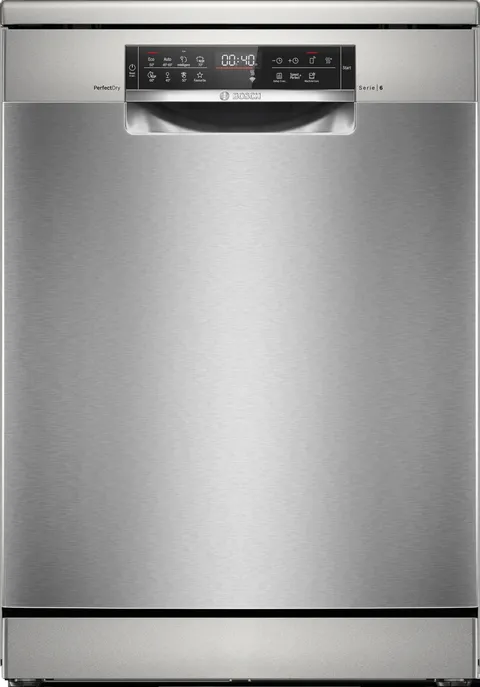
Bosch
Serie 6 SMS6ZCI16E
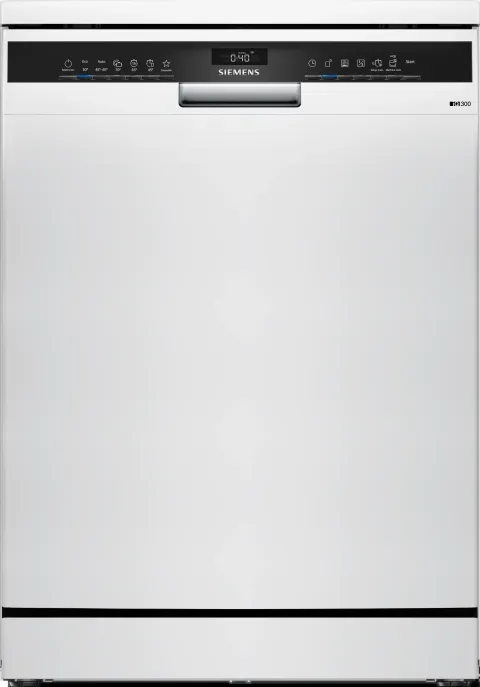
Siemens
iQ300 SN23EW03ME
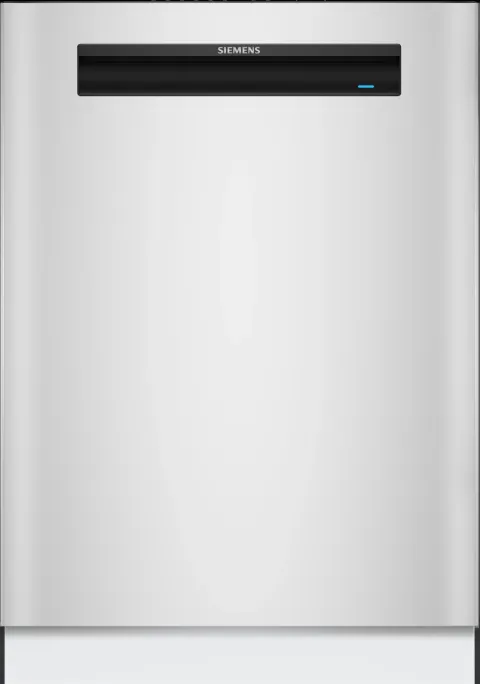
Siemens
iQ500 SN15EW06CS
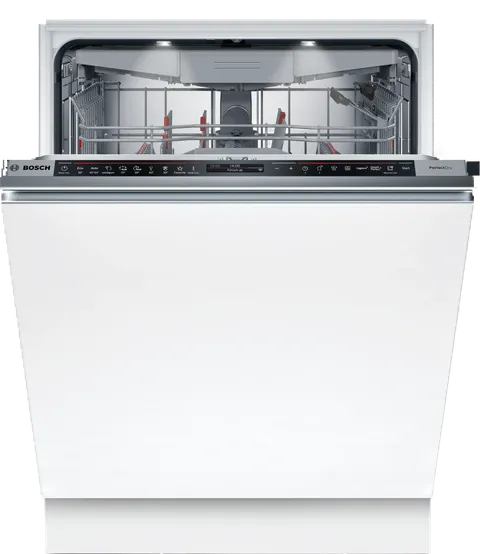
Bosch
Serie 8 SMD8TCX04E
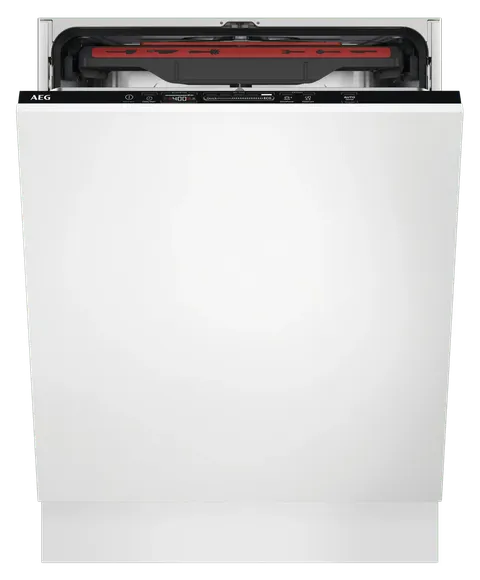
AEG
6000 SatelliteClean FSK64907Z

LG
DB476TXS
Related categories
Frequently asked questions
Does a quieter dishwasher use less electricity? +
Not reliably. In our database, dishwashers rated 40 decibels use exactly as much energy per cycle (65 kWh per 100 cycles, energy class B) as some models rated 42 decibels that cost hundreds of euros less. Noise and energy efficiency are separate ratings on the EU label, and in this dataset they do not move together.
What does the jump from energy class B to A actually save on a dishwasher? +
At the same 42-decibel rating, class B models in our database use 65 kWh per 100 cycles and class A models use 54 kWh, an 11 kWh difference. At 260 cycles a year and CompareHomeAppliances' own 0.40 EUR/kWh reference tariff, that is about 11.44 EUR a year, meaning a 200 EUR price gap between the two takes roughly 17.5 years of electricity savings to earn back.
Why do two dishwashers with the same decibel rating cost such different prices? +
Because decibels only measure noise. Program count, an automatic drying-door feature, brand tier, and, up to one point, energy class all vary independently of the dB number, and any of them can explain a large part of the price gap between two equally quiet machines.
Should I ignore the noise class letter (A to G) on a dishwasher's energy label? +
Not ignore it, but do not expect it to distinguish machines closely. Every full-size dishwasher we track between 40 and 44 decibels carries the identical class-B noise rating; the letter only separates much louder compact and slimline models. Compare the actual decibel number and the energy-per-cycle figure, not the letter.
Sources
- European Commission - Energy-efficient products (energy label and ecodesign)
- Bosch - Serie 6 SMS6ZCI16E official product page
- Siemens - iQ300 SN23EW03ME official product page
- Siemens - iQ500 SN15EW06CS official product page
- Bosch - Serie 8 SMD8TCX04E official product page
- EPREL - Bosch Serie 6 SMS6ZCI16E energy label
More from the blog